So, one of the most common questions about corsets is how to clean them. Usually the answer is Dry Cleaning, because that's a safe option for most everything.
But if you're like me, you're way too lazy to take a corset to the cleaners, and you want options. First, I recommend always laying a corset flat, with the inside facing up when you take it off. This allows moisture and odor to evaporate instead of setting into the fabric. You can freshen a corset by spraying it with a mixture of 50/50 water/vodka to remove odors. (You could also use Febreze, but it tends to leave a residue some people dislike.) For stains you can spot clean a corset with water/soap/stain remover, depending on the outer fabric. (Silk may permanently stain with water.)
I tend to keep my corsets in shape with a combination of the above techniques and it works fairly well for my occasionally worn costume corsets. But for my daily wear corsets, those are not enough. I wear my corsets around the house, on the outside of my clothes, and I do a lot in them. I try to wear an apron when doing something messy, but I often forget. I cook, sew, and craft in my corsets, so there are often things spilled or sprayed on them.
My previous daily wear corset got particularly grungey. I had gotten flour on it while baking, as well as who knows what else. Spot cleaning wasn't going to work. So I figured What The Hell and threw it in the washing machine.
The reasons usually given for not machine washing corsets are that the water will cause the bones to rust, and that it may shrink the fabric. If you have a corset with fancy exterior, like silk or with any embellishment this is obviously not recommended and you're going to need to head to the dry cleaners.
But this corset was a one layer cotton coutil corset, so I wasn't really worried. When the wash cycle was finished I threw the corset in the dryer, too. Let's go for broke. If it had been a nice, hot day I would have set it out flat in the sun to dry, but it was cold and rainy.
So what happened? Well there was some shrinkage of the coutil. Coutil is generally not pre-washed because the fabric contains sizing to make it stiff. I didn't do any scientific measurement of the corset before/after but it fit a little more snugly. It felt a big like an un-seasoned corset again. As it had been worn daily for several months at that point, I didn't mind. It had started to feel a bit stretched out.
I wore the corset for another six months, and machine washed it a second time in those months. (I didn't notice any shrinkage the second time.)
And finally the corset reached the end of it's life. I had already patched a couple of worn spots and one of the flat steel bones at the back snapped in two. So I took the corset apart, and inspected the bones.

Showing posts with label corset myths. Show all posts
Showing posts with label corset myths. Show all posts
Monday, April 27, 2015


Thursday, April 18, 2013
Corset Myth #3: Corsets Are Bad For Your Health
Previous posts in this series are here and here.
Corset Myth #3: Corsets Are Bad For Your Health
This is a really difficult myth to escape. Corset wearers are used to receiving comments online whenever they post pictures of themselves in corsets about how bad the corset is for their body. These comments are generally based on nothing in particular, except for the fact that everyone knows corsets are bad for you.
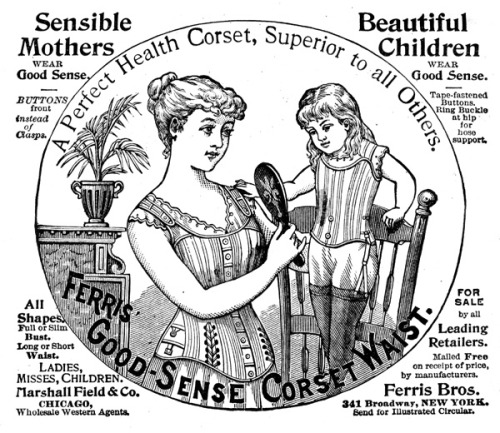 But where did this idea that corsets are bad for your health come from? Well, for one thing it's repeated ad infinitum in modern media and fiction. But the first rumblings about negative health effects of corseting started in the Victorian period, and generally came from two sources: doctors and quack medicine purveyors, and the corset industry itself.
So first let's consider how much we should trust anything a Victorian era doctor says about anything. No, really, think about that. Now consider that corsets were blamed for a lot of conditions when they affected women and the doctors didn't understand what was happening. Never mind that these same conditions also affected men. The problems which doctors of the time would attribute to corsets we now understand to be symptoms with other causes. (See this excellent article for specifics. )
So why would corset manufacturers talk about negative health effects of corsets? Why, to tell you that THEIR brand of corset didn't cause those problems, of course. So called "health corsets" were big business at the time, though looking at the patent drawings, there is rarely any significant difference from other corsets. They are still corsets meant to tightly cinch the waist, which is what people would assume causes the health problems.
But what health problems are corsets supposed to cause? You know, I'm not entirely sure, because anonymous internet commenting is so rarely specific. People will mention skeletal deformation and moving organs around. So let's talk about those.
 You've probably seen images something like this, which are sometimes used to show the extreme effect corseting has on the body. First of all, comparing the effects of corseting in the Victorian period on women's bodies to modern corseting isn't really fair, because in the period girls started wearing corsets at a young age, and their rib cages grew into a conical shape as they aged. This is an effect that is nearly impossible to achieve by someone who starts wearing corsets as an adult, once the bones have fully ossified. The only part of the ribs that can actually be reshaped with dedicated, daily waist training are the floating ribs.
While I'm on the subject of ribs, can we please put to rest for once and for all the idea that women have EVER, especially in the Victorian period, had ribs surgically removed? I had someone bring this up to me just a couple of weeks ago. There was no such thing as elective cosmetic surgery in the Victorian period. Mostly due to the extreme chance of death that ALL surgery carried in the time before the discovery of antibiotics. Moreover, Victorian women had no need to have ribs removed, because lifelong waist training meant their ribs were already trained to a stylish shape.
But for the most part, modern corsets do not compress the ribs, and instead focus on the fleshy waist area between ribs and hips. You will see, even with serious tightlacers, that their ribs tend to be much larger than their waist. As I mentioned, it takes daily wearing, sometimes up to 23 hours a day to reshape the floating ribs. So the typical way in which we wear corsets today (for special occasions, for costuming, on the weekend) has really no chance of making any permanent changes to the skeleton.
 What about the organs? Does corseting sometimes shift and restrict the organs of the body? The answer is yes, but it doesn't follow that it is harmful. The biggest effect corseting has on the body is that it restricts the space that the hollow organs such as the stomach and intestines have to expand. Which means that you can't eat as much while wearing a corset, and should avoid all carbonated beverages, since there isn't room for expansion. Trust me on this one, you will become very uncomfortable if you are tightly laced and you drink a bunch of carbonation.
But the extent to which corseting shifts your organs is extremely minor compared to how much they shift during pregnancy. This is one reason why women can achieve much greater reduction with corsets (at least initially) than men, because our organs are meant to easily shift around.
The final negative health effect of corseting that will sometimes be mentioned is that corseting weakens the muscles of the back and abdomen. You will often hear that Victorian women couldn't even stand up without their corsets because their muscles were so weak. That claim brings out my skeptical face, because certainly women spent time out of their corsets and were able to move around. I will allow that possibly some women had difficulty standing for lengthy periods of time without a corset. But you have to remember, again, that these are women who wore corsets their entire lives and therefore never developed the musculature all of us have as a matter of course.
Can habitually or constantly wearing corsets weaken the muscles of the back and abdomen? Yes. By taking the strain off those muscles, they get less use. Corset wearing does not result in six-pack abs. Is it possible that weakening these muscles by daily corset wear over a long period of time could result in back problems when not corseted? Yes.
Personally, I have very severe back problems, that started at the age of 17 and involve deterioration of my spine. I started wearing corsets as an aid to my back problems, because I couldn't stand for longer than 10 minutes and couldn't sit upright longer than 30 minutes. With a corset, I can stand for up to 30 minutes and sit for up to 4 hours. So it's a significant aid for me to have the support of the corset and the light traction it provides my spine. So I certainly believe that corsets can be extremely beneficial for back problems. But I will also always recommend that anyone who wears corsets daily also commit to doing some back strengthening exercises. Yoga is fantastic for this, but you can also find simple routines and exercises online to make sure your back and ab muscles don't deteriorate.
So as I hope you see, there simply isn't evidence of serious health problems arising from corset wearing. Even with the most severe reductions of tightlacing waist trainers, corsets can be worn safely. Naturally if you have any discomfort or problems that arise, you should loosen or remove your corset. Trying to tighten a corset too severely or too quickly can lead to temporary problems. Also some things such as overeating, consuming carbonated beverages, not hydrating, etc, can lead to problems while wearing a corset and you should educate yourself about corseting "best practices." But wearing a corset is certainly not dangerous and does not damage the body.
Do you have any stories about corseting and health? Are there other myths you want to see me tackle? Share in the comments.
Corset Myth Series:
Myth #1: Corsets Are Painful
Myth #2: You Can't Breathe In A Corset
Myth #3: Corsets Are Bad For Your Health
Corset Myth #3: Corsets Are Bad For Your Health
This is a really difficult myth to escape. Corset wearers are used to receiving comments online whenever they post pictures of themselves in corsets about how bad the corset is for their body. These comments are generally based on nothing in particular, except for the fact that everyone knows corsets are bad for you.
So first let's consider how much we should trust anything a Victorian era doctor says about anything. No, really, think about that. Now consider that corsets were blamed for a lot of conditions when they affected women and the doctors didn't understand what was happening. Never mind that these same conditions also affected men. The problems which doctors of the time would attribute to corsets we now understand to be symptoms with other causes. (See this excellent article for specifics. )
So why would corset manufacturers talk about negative health effects of corsets? Why, to tell you that THEIR brand of corset didn't cause those problems, of course. So called "health corsets" were big business at the time, though looking at the patent drawings, there is rarely any significant difference from other corsets. They are still corsets meant to tightly cinch the waist, which is what people would assume causes the health problems.
But what health problems are corsets supposed to cause? You know, I'm not entirely sure, because anonymous internet commenting is so rarely specific. People will mention skeletal deformation and moving organs around. So let's talk about those.

While I'm on the subject of ribs, can we please put to rest for once and for all the idea that women have EVER, especially in the Victorian period, had ribs surgically removed? I had someone bring this up to me just a couple of weeks ago. There was no such thing as elective cosmetic surgery in the Victorian period. Mostly due to the extreme chance of death that ALL surgery carried in the time before the discovery of antibiotics. Moreover, Victorian women had no need to have ribs removed, because lifelong waist training meant their ribs were already trained to a stylish shape.
But for the most part, modern corsets do not compress the ribs, and instead focus on the fleshy waist area between ribs and hips. You will see, even with serious tightlacers, that their ribs tend to be much larger than their waist. As I mentioned, it takes daily wearing, sometimes up to 23 hours a day to reshape the floating ribs. So the typical way in which we wear corsets today (for special occasions, for costuming, on the weekend) has really no chance of making any permanent changes to the skeleton.
 What about the organs? Does corseting sometimes shift and restrict the organs of the body? The answer is yes, but it doesn't follow that it is harmful. The biggest effect corseting has on the body is that it restricts the space that the hollow organs such as the stomach and intestines have to expand. Which means that you can't eat as much while wearing a corset, and should avoid all carbonated beverages, since there isn't room for expansion. Trust me on this one, you will become very uncomfortable if you are tightly laced and you drink a bunch of carbonation.
But the extent to which corseting shifts your organs is extremely minor compared to how much they shift during pregnancy. This is one reason why women can achieve much greater reduction with corsets (at least initially) than men, because our organs are meant to easily shift around.
The final negative health effect of corseting that will sometimes be mentioned is that corseting weakens the muscles of the back and abdomen. You will often hear that Victorian women couldn't even stand up without their corsets because their muscles were so weak. That claim brings out my skeptical face, because certainly women spent time out of their corsets and were able to move around. I will allow that possibly some women had difficulty standing for lengthy periods of time without a corset. But you have to remember, again, that these are women who wore corsets their entire lives and therefore never developed the musculature all of us have as a matter of course.
Can habitually or constantly wearing corsets weaken the muscles of the back and abdomen? Yes. By taking the strain off those muscles, they get less use. Corset wearing does not result in six-pack abs. Is it possible that weakening these muscles by daily corset wear over a long period of time could result in back problems when not corseted? Yes.
Personally, I have very severe back problems, that started at the age of 17 and involve deterioration of my spine. I started wearing corsets as an aid to my back problems, because I couldn't stand for longer than 10 minutes and couldn't sit upright longer than 30 minutes. With a corset, I can stand for up to 30 minutes and sit for up to 4 hours. So it's a significant aid for me to have the support of the corset and the light traction it provides my spine. So I certainly believe that corsets can be extremely beneficial for back problems. But I will also always recommend that anyone who wears corsets daily also commit to doing some back strengthening exercises. Yoga is fantastic for this, but you can also find simple routines and exercises online to make sure your back and ab muscles don't deteriorate.
So as I hope you see, there simply isn't evidence of serious health problems arising from corset wearing. Even with the most severe reductions of tightlacing waist trainers, corsets can be worn safely. Naturally if you have any discomfort or problems that arise, you should loosen or remove your corset. Trying to tighten a corset too severely or too quickly can lead to temporary problems. Also some things such as overeating, consuming carbonated beverages, not hydrating, etc, can lead to problems while wearing a corset and you should educate yourself about corseting "best practices." But wearing a corset is certainly not dangerous and does not damage the body.
Do you have any stories about corseting and health? Are there other myths you want to see me tackle? Share in the comments.
Corset Myth Series:
Myth #1: Corsets Are Painful
Myth #2: You Can't Breathe In A Corset
Myth #3: Corsets Are Bad For Your Health
Friday, March 29, 2013
Corset Myth #2: You Can't Breathe In A Corset
Corset Myth #2: You can't breathe in a corset.
The number one most frequent comment I get when I'm wearing a corset is "Can you breathe in that?" (Ok, maybe it's second after "nice corset.") I was just at a con last weekend, and I got this comment at least 5 times, including once when a young man accosted me and demanded I explain to his girlfriend that I could breathe in my corset.
So I'll give you the answer I give people who ask me this: yes. A corset, at least a Victorian styled corset (and therefore most modern corsets) squeezes you at the waist. My lungs are not in my waist. Therefore I can breathe perfectly fine, thank you.
As I discussed in the previous article in this series, a properly fitted corset has plenty of room in the bust area, which is where the lungs are located, after all. Generally with my own corsets, I can stick a whole hand and arm down the top of my corset. So there is plenty of room for the ribcage and therefore lungs to expand. As with many corset myths, this one gets reinforced by people who wear poorly fitting corsets. Many women buy off-the-rack corsets that are two small in the bust, and therefore end up being uncomfortable and feel like their breathing is restricted.
But there is a little bit of truth in this myth. Corsets do restrict your lung capacity a bit, and it naturally varies by the corset and by how tightly laced the corset is. Statistics I've read indicate that at the very maximum, corsets can restrict your lung capacity by about 30%. Note, that's the most tightly laced corsets out there. But on any average breath you take, you only use 10-15% of your lung capacity, so it's unlikely that you'll notice any restriction, unless you try to do something that requires 70% or more of your lung capacity.
So I would never recommend you go running in a corset. But you should be able to go dancing, so long as you don't try anything...extreme. The only times I've felt my breath was restricted in a corset was once when I quickly climbed two flights of stairs and once when I was singing very enthusiastically during a game of Rock Band. Singing requires deep breathing from the diaphragm, especially if you've been trained at all, and corsets can restrict this somewhat. Which is why opera singers have a history of having specially made corsets that leave more room for them to breathe deeply. It's also why opera costumes for women were made very wide in the shoulders and hips, to make the waist look small without actually lacing it very tightly.

Finally, I've found that underbust corsets actually can be more restrictive of breathing than properly fitting overbust corsets. Because the top of an underbust is at the rib-cage if it fits too tightly, it can leave less room for the rib-cage to expand. Whereas an overbust has more room in the underbust, since it is slanting up and out over the bust, leaving empty space right below the bust. I have a large rib-cage and I have to be careful not to lace the top of my underbust too tightly, or I start to notice that I can't fully expand my lungs. So that's something to keep in mind when you're buying or making an underbust: make sure there is a little extra room at the top to allow for rib-cage expansion.
One of the things you will eventually hear about corsets is that Victorian women were always fainting because their corsets were too tight. I find this very difficult to believe. I've never known anyone wearing a corset to feel faint as a result, no matter how tightly laced they were. There are, of course, lots of medical reasons why someone might faint that may not have been understood in the period. Certainly overheating would be a danger, given the layers of clothing worn and the lack of air conditioning. I've read a theory that it was actually due to the prevalence of gas lighting, that in a tightly closed room the gas lighting actually used up much of the oxygen in the room, leading to fainting. Women were affected by this more than men because they spent so much more time at home and indoors. And finally, it may have simply become fashionable for a woman to swoon occasionally, not to mention convenient in fiction.
But the bottom line is that wearing a corset shouldn't mean you can't breathe properly.
Next myth in this series: Corsets are bad for your health.
Corset Myth Series:
Myth #1: Corsets Are Painful
Myth #2: You Can't Breathe In A Corset
Myth #3: Corsets Are Bad For Your Health
The number one most frequent comment I get when I'm wearing a corset is "Can you breathe in that?" (Ok, maybe it's second after "nice corset.") I was just at a con last weekend, and I got this comment at least 5 times, including once when a young man accosted me and demanded I explain to his girlfriend that I could breathe in my corset.
So I'll give you the answer I give people who ask me this: yes. A corset, at least a Victorian styled corset (and therefore most modern corsets) squeezes you at the waist. My lungs are not in my waist. Therefore I can breathe perfectly fine, thank you.
 |
| Note the distance between my waist and the fullest part of my chest. Also note that I am breathing, evidenced by the fact that I'm not dead yet. |
As I discussed in the previous article in this series, a properly fitted corset has plenty of room in the bust area, which is where the lungs are located, after all. Generally with my own corsets, I can stick a whole hand and arm down the top of my corset. So there is plenty of room for the ribcage and therefore lungs to expand. As with many corset myths, this one gets reinforced by people who wear poorly fitting corsets. Many women buy off-the-rack corsets that are two small in the bust, and therefore end up being uncomfortable and feel like their breathing is restricted.
But there is a little bit of truth in this myth. Corsets do restrict your lung capacity a bit, and it naturally varies by the corset and by how tightly laced the corset is. Statistics I've read indicate that at the very maximum, corsets can restrict your lung capacity by about 30%. Note, that's the most tightly laced corsets out there. But on any average breath you take, you only use 10-15% of your lung capacity, so it's unlikely that you'll notice any restriction, unless you try to do something that requires 70% or more of your lung capacity.
So I would never recommend you go running in a corset. But you should be able to go dancing, so long as you don't try anything...extreme. The only times I've felt my breath was restricted in a corset was once when I quickly climbed two flights of stairs and once when I was singing very enthusiastically during a game of Rock Band. Singing requires deep breathing from the diaphragm, especially if you've been trained at all, and corsets can restrict this somewhat. Which is why opera singers have a history of having specially made corsets that leave more room for them to breathe deeply. It's also why opera costumes for women were made very wide in the shoulders and hips, to make the waist look small without actually lacing it very tightly.

Finally, I've found that underbust corsets actually can be more restrictive of breathing than properly fitting overbust corsets. Because the top of an underbust is at the rib-cage if it fits too tightly, it can leave less room for the rib-cage to expand. Whereas an overbust has more room in the underbust, since it is slanting up and out over the bust, leaving empty space right below the bust. I have a large rib-cage and I have to be careful not to lace the top of my underbust too tightly, or I start to notice that I can't fully expand my lungs. So that's something to keep in mind when you're buying or making an underbust: make sure there is a little extra room at the top to allow for rib-cage expansion.
One of the things you will eventually hear about corsets is that Victorian women were always fainting because their corsets were too tight. I find this very difficult to believe. I've never known anyone wearing a corset to feel faint as a result, no matter how tightly laced they were. There are, of course, lots of medical reasons why someone might faint that may not have been understood in the period. Certainly overheating would be a danger, given the layers of clothing worn and the lack of air conditioning. I've read a theory that it was actually due to the prevalence of gas lighting, that in a tightly closed room the gas lighting actually used up much of the oxygen in the room, leading to fainting. Women were affected by this more than men because they spent so much more time at home and indoors. And finally, it may have simply become fashionable for a woman to swoon occasionally, not to mention convenient in fiction.
But the bottom line is that wearing a corset shouldn't mean you can't breathe properly.
Next myth in this series: Corsets are bad for your health.
Corset Myth Series:
Myth #1: Corsets Are Painful
Myth #2: You Can't Breathe In A Corset
Myth #3: Corsets Are Bad For Your Health
Friday, March 15, 2013
Corset Myth #1: Corsets are Painful
This is a post that I always THINK I've already made, but I have to remind myself I actually haven't. Partly it's because this is part of my corsetmaking panel presentation, partly it's because I've linked to a bunch of great articles about corset myths.
But these myths and questions come up over and over again when you talk about wearing corsets. I hear steampunks repeat them as often as people in the general populace. So let's address the most common misconceptions about corsets. I'm going to do this over a series of posts, since I can get wordy on the subject.
1. Corsets are painful.
Look, I'm only going to say this once. If you are in actual PAIN while wearing a corset, YOU ARE WEARING THE WRONG CORSET.
I like to think of corsets as being the same type of garment as shoes. Imagine you walk into a shoe store (or worse, a shoe website) and you've never worn a pair of shoes before in your life. You don't know your size, you don't know what kind of shoes you like or find comfortable, you're not aware of any special foot issues that require special shoe features. You take a guess at what pair and size of shoe you need just by looking at it. Would it surprise you if you put the shoe on and it hurt? Probably not.
This is how most people buy corsets the first time. We don't have a lifetime of experience wearing and buying corsets the way we do shoes, so we have no clue what we're doing. Sometimes, maybe we get lucky, or are able to make educated guesses about what we need. But often, we end up with the wrong corset, in the wrong size, made of the wrong materials.
Just like shoes, the cheaper they are, the worse they fit, the quicker they fall apart, and the more likely they are to be uncomfortable. Just like shoes many of us have body shapes that require certain features in our corsets. I have ridiculously high arches and therefore have to be very, very picky about what shoes I wear, otherwise I can develop so much pain that I can't walk. With corsets, we all have such different bust size, bust-to-waist-to-hip ratio, ribcage size, etc, that it's a miracle anyone can wear standard sized corsets at all.
So, why might a corset be painful? First of all, it might be really cheap. If you're trying to wear a $15 corset made in China, I have found your problem. Cheap fabric that doesn't support and shape the body, flimsy plastic boning, horrible shape...these things all make an uncomfortable corset. The plastic boning especially is terrible because it buckles under the stress of lacing and will end up poking you uncomfortably. Trust me. This is how I started wearing corsets.
So let's say you are wearing a slightly higher priced and higher quality corset. You listened to someone and bought a corset with steel boning. But it's still hurting you. It's probably either the wrong size or simply not a shape that works for your figure. Off the rack corsets are made to fit the largest amount of people, which means they are made for an average figure. I think very few of us actually have an average figure. If you have hips or bust that are either significantly larger or smaller than this average, it's going to be difficult to find an off the rack corset that fits you really well.
A lot of women buy a corset by the waist size. They want to wear a corset to cinch in their waist, so they pick a corset with a size smaller than their waist size. (Which is fine.) But with an OTR corset, there's not usually a very dramatic hourglass figure, so you often end up with a bust and/or hip that is too small. Which is uncomfortable. You wind up trying to lace into a corset that is too small all over, which ends up with you squeezed like a sausage in a casing. Whereas in order to actually reduce your waist, you need plenty of room in your hips and bust, because you can't actually just squeeze and make the human body smaller. All you can do is temporarily redistribute the excess.
I've had women ask me how I get such a dramatic waist cinch (which actually isn't that much of a reduction, I'm just a pretty extreme hourglass normally.) I started into a whole explanation of corsetmaking principles, before I realized what they really meant was "I bought a corset online, how do I get it to be shaped like that?" And the answer is: you don't.
Now there are some corset sellers out there who sell curvier OTR corsets, but you're going to be paying for it. This is also why people have a lot more success with buying OTR underbust corsets, because those darn boobs cause 70% of the problems.
So, let's say you have a well-fitted, high quality corset. Will it ever be painful to wear? Well, this depends, again, on the corset. If you are tightlacing and going for a really large reduction, well, yes, it might be painful. In which case you probably shouldn't be trying that much reduction. The more severe the reduction, the less time I can comfortably wear a corset, I find. Eventually, after several hours, it feels good to be out of a corset. But in my most comfortable corset, (my steampunk patch corset, fyi) it's not a problem to wear it for 12-14 hours.
Next time on Corset Myths: "Can you breathe in that?"
Corset Myth Series:
Myth #1: Corsets Are Painful
Myth #2: You Can't Breathe In A Corset
Myth #3: Corsets Are Bad For Your Health
But these myths and questions come up over and over again when you talk about wearing corsets. I hear steampunks repeat them as often as people in the general populace. So let's address the most common misconceptions about corsets. I'm going to do this over a series of posts, since I can get wordy on the subject.
 |
| One shape does NOT fit all. |
1. Corsets are painful.
Look, I'm only going to say this once. If you are in actual PAIN while wearing a corset, YOU ARE WEARING THE WRONG CORSET.
I like to think of corsets as being the same type of garment as shoes. Imagine you walk into a shoe store (or worse, a shoe website) and you've never worn a pair of shoes before in your life. You don't know your size, you don't know what kind of shoes you like or find comfortable, you're not aware of any special foot issues that require special shoe features. You take a guess at what pair and size of shoe you need just by looking at it. Would it surprise you if you put the shoe on and it hurt? Probably not.
This is how most people buy corsets the first time. We don't have a lifetime of experience wearing and buying corsets the way we do shoes, so we have no clue what we're doing. Sometimes, maybe we get lucky, or are able to make educated guesses about what we need. But often, we end up with the wrong corset, in the wrong size, made of the wrong materials.
Just like shoes, the cheaper they are, the worse they fit, the quicker they fall apart, and the more likely they are to be uncomfortable. Just like shoes many of us have body shapes that require certain features in our corsets. I have ridiculously high arches and therefore have to be very, very picky about what shoes I wear, otherwise I can develop so much pain that I can't walk. With corsets, we all have such different bust size, bust-to-waist-to-hip ratio, ribcage size, etc, that it's a miracle anyone can wear standard sized corsets at all.
So, why might a corset be painful? First of all, it might be really cheap. If you're trying to wear a $15 corset made in China, I have found your problem. Cheap fabric that doesn't support and shape the body, flimsy plastic boning, horrible shape...these things all make an uncomfortable corset. The plastic boning especially is terrible because it buckles under the stress of lacing and will end up poking you uncomfortably. Trust me. This is how I started wearing corsets.
So let's say you are wearing a slightly higher priced and higher quality corset. You listened to someone and bought a corset with steel boning. But it's still hurting you. It's probably either the wrong size or simply not a shape that works for your figure. Off the rack corsets are made to fit the largest amount of people, which means they are made for an average figure. I think very few of us actually have an average figure. If you have hips or bust that are either significantly larger or smaller than this average, it's going to be difficult to find an off the rack corset that fits you really well.
A lot of women buy a corset by the waist size. They want to wear a corset to cinch in their waist, so they pick a corset with a size smaller than their waist size. (Which is fine.) But with an OTR corset, there's not usually a very dramatic hourglass figure, so you often end up with a bust and/or hip that is too small. Which is uncomfortable. You wind up trying to lace into a corset that is too small all over, which ends up with you squeezed like a sausage in a casing. Whereas in order to actually reduce your waist, you need plenty of room in your hips and bust, because you can't actually just squeeze and make the human body smaller. All you can do is temporarily redistribute the excess.
I've had women ask me how I get such a dramatic waist cinch (which actually isn't that much of a reduction, I'm just a pretty extreme hourglass normally.) I started into a whole explanation of corsetmaking principles, before I realized what they really meant was "I bought a corset online, how do I get it to be shaped like that?" And the answer is: you don't.
Now there are some corset sellers out there who sell curvier OTR corsets, but you're going to be paying for it. This is also why people have a lot more success with buying OTR underbust corsets, because those darn boobs cause 70% of the problems.
So, let's say you have a well-fitted, high quality corset. Will it ever be painful to wear? Well, this depends, again, on the corset. If you are tightlacing and going for a really large reduction, well, yes, it might be painful. In which case you probably shouldn't be trying that much reduction. The more severe the reduction, the less time I can comfortably wear a corset, I find. Eventually, after several hours, it feels good to be out of a corset. But in my most comfortable corset, (my steampunk patch corset, fyi) it's not a problem to wear it for 12-14 hours.
Next time on Corset Myths: "Can you breathe in that?"
Corset Myth Series:
Myth #1: Corsets Are Painful
Myth #2: You Can't Breathe In A Corset
Myth #3: Corsets Are Bad For Your Health
Subscribe to:
Posts (Atom)