Friday, March 29, 2013

Corset Myth #2: You Can't Breathe In A Corset

Corset Myth #2: You can't breathe in a corset.

The number one most frequent comment I get when I'm wearing a corset is "Can you breathe in that?" (Ok, maybe it's second after "nice corset.")  I was just at a con last weekend, and I got this comment at least 5 times, including once when a young man accosted me and demanded I explain to his girlfriend that I could breathe in my corset.

So I'll give you the answer I give people who ask me this: yes.  A corset, at least a Victorian styled corset (and therefore most modern corsets) squeezes you at the waist.  My lungs are not in my waist.  Therefore I can breathe perfectly fine, thank you.

Note the distance between my waist and the fullest part of my chest.
Also note that I am breathing, evidenced by the fact that I'm not dead yet.


As I discussed in the previous article in this series, a properly fitted corset has plenty of room in the bust area, which is where the lungs are located, after all.  Generally with my own corsets, I can stick a whole hand and arm down the top of my corset.  So there is plenty of room for the ribcage and therefore lungs to expand.  As with many corset myths, this one gets reinforced by people who wear poorly fitting corsets.  Many women buy off-the-rack corsets that are two small in the bust, and therefore end up being uncomfortable and feel like their breathing is restricted.

But there is a little bit of truth in this myth.  Corsets do restrict your lung capacity a bit, and it naturally varies by the corset and by how tightly laced the corset is.  Statistics I've read indicate that at the very maximum, corsets can restrict your lung capacity by about 30%.  Note, that's the most tightly laced corsets out there.  But on any average breath you take, you only use 10-15% of your lung capacity, so it's unlikely that you'll notice any restriction, unless you try to do something that requires 70% or more of your lung capacity.

So I would never recommend you go running in a corset.  But you should be able to go dancing, so long as you don't try anything...extreme.  The only times I've felt my breath was restricted in a corset was once when I quickly climbed two flights of stairs and once when I was singing very enthusiastically during a game of Rock Band.  Singing requires deep breathing from the diaphragm, especially if you've been trained at all, and corsets can restrict this somewhat.  Which is why opera singers have a history of having specially made corsets that leave more room for them to breathe deeply.  It's also why opera costumes for women were made very wide in the shoulders and hips, to make the waist look small without actually lacing it very tightly.

Finally, I've found that underbust corsets actually can be more restrictive of breathing than properly fitting overbust corsets.  Because the top of an underbust is at the rib-cage  if it fits too tightly, it can leave less room for the rib-cage to expand.  Whereas an overbust has more room in the underbust, since it is slanting up and out over the bust, leaving empty space right below the bust.  I have a large rib-cage  and I have to be careful not to lace the top of my underbust too tightly, or I start to notice that I can't fully expand my lungs. So that's something to keep in mind when you're buying or making an underbust: make sure there is a little extra room at the top to allow for rib-cage expansion.

One of the things you will eventually hear about corsets is that Victorian women were always fainting because their corsets were too tight.  I find this very difficult to believe.  I've never known anyone wearing a corset to feel faint as a result, no matter how tightly laced they were.  There are, of course, lots of medical reasons why someone might faint that may not have been understood in the period. Certainly overheating would be a danger, given the layers of clothing worn and the lack of air conditioning.  I've read a theory that it was actually due to the prevalence of gas lighting, that in a tightly closed room the gas lighting actually used up much of the oxygen in the room, leading to fainting.  Women were affected by this more than men because they spent so much more time at home and indoors.   And finally, it may have simply become fashionable for a woman to swoon occasionally, not to mention convenient in fiction.

But the bottom line is that wearing a corset shouldn't mean you can't breathe properly.

Next myth in this series: Corsets are bad for your health.

Corset Myth Series:
Myth #1: Corsets Are Painful
Myth #2: You Can't Breathe In A Corset
Myth #3: Corsets Are Bad For Your Health

Monday, March 25, 2013

Twelve More Steampunk Fonts


While downloading some fonts onto my husbands netbook, I one again got sucked into looking at fonts.  Which means you get another compilation of the best steampunk fonts I could find.  Looking at hundreds of fonts and asking yourself, "Is this steampunk?" is an interesting exercise.  You have to start thinking about what a steampunk style really is, at its core.  I decided steampunk included some combination of the following attributes: antique, distressed, and elaborate.

Fleet Street - This font looks like old newspaper headline print.  Simple but antiquated.


Admiration Pains -This may look impossible to read, but with only the first letter of each word capitalized, it looks really neat.


Arrr Matey BB - A pirate-y font.


Moonshiner Sharp - Another bold title font, this would be great for advertisements.


Old Printing Press - I adore this distressed and messy typeface.


Handwriting Draft - I love the barely there drafting lines in this one.

Renny Hybrid - Elegant, antique, and modern.

Ornamental Versals - For that Victorian storybook feel.


Feathergraphy Decoration - Elaborate calligraphy with a touch of attitude.


Sucker Font - Yes, I realize this is a version of the Sucker Punch font, and I try to avoid movie fonts, but this font is too great to pass up.  Also, it's not ultra-recognizable.


Crimson Petal - A book/miniseries font (The Crimson Petal and the White). I like the rounded and distressed type.


Geared Up - Speaks for itself a bit, don't it?

Wednesday, March 20, 2013

Sepiachord Interview

I was interviewed by the website Sepiachord.com, my fellow nominee in the Best Blog category for the Steampunk Chronicle Reader's Choice Awards.


So if you want to read my thoughts on all things steampunk and this blog, check out the interview.

Friday, March 15, 2013

Corset Myth #1: Corsets are Painful

This is a post that I always THINK I've already made, but I have to remind myself I actually haven't.  Partly it's because this is part of my corsetmaking panel presentation, partly it's because I've linked to a bunch of great articles about corset myths.

But these myths and questions come up over and over again when you talk about wearing corsets.  I hear steampunks repeat them as often as people in the general populace.  So let's address the most common misconceptions about corsets.  I'm going to do this over a series of posts, since I can get wordy on the subject.
One shape does NOT fit all.

1. Corsets are painful.
Look, I'm only going to say this once.  If you are in actual PAIN while wearing a corset, YOU ARE WEARING THE WRONG CORSET.

I like to think of corsets as being the same type of garment as shoes.  Imagine you walk into a shoe store (or worse, a shoe website) and you've never worn a pair of shoes before in your life.  You don't know your size, you don't know what kind of shoes you like or find comfortable, you're not aware of any special foot issues that require special shoe features.  You take a guess at what pair and size of shoe you need just by looking at it.  Would it surprise you if you put the shoe on and it hurt?  Probably not.

This is how most people buy corsets the first time.  We don't have a lifetime of experience wearing and buying corsets the way we do shoes, so we have no clue what we're doing.  Sometimes, maybe we get lucky, or are able to make educated guesses about what we need.  But often, we end up with the wrong corset, in the wrong size, made of the wrong materials.

Just like shoes, the cheaper they are, the worse they fit, the quicker they fall apart, and the more likely they are to be uncomfortable.  Just like shoes many of us have body shapes that require certain features in our corsets.  I have ridiculously high arches and therefore have to be very, very picky about what shoes I wear, otherwise I can develop so much pain that I can't walk.  With corsets, we all have such different bust size, bust-to-waist-to-hip ratio, ribcage size, etc, that it's a miracle anyone can wear standard sized corsets at all.

So, why might a corset be painful?  First of all, it might be really cheap.  If you're trying to wear a $15 corset made in China, I have found your problem.  Cheap fabric that doesn't support and shape the body, flimsy plastic boning, horrible shape...these things all make an uncomfortable corset.  The plastic boning especially is terrible because it buckles under the stress of lacing and will end up poking you uncomfortably.  Trust me.  This is how I started wearing corsets.

So let's say you are wearing a slightly higher priced and higher quality corset.  You listened to someone and bought a corset with steel boning.  But it's still hurting you.  It's probably either the wrong size or simply not a shape that works for your figure.  Off the rack corsets are made to fit the largest amount of people, which means they are made for an average figure.  I think very few of us actually have an average figure.  If you have hips or bust that are either significantly larger or smaller than this average, it's going to be difficult to find an off the rack corset that fits you really well.

A lot of women buy a corset by the waist size.  They want to wear a corset to cinch in their waist, so they pick a corset with a size smaller than their waist size.  (Which is fine.) But with an OTR corset, there's not usually a very dramatic hourglass figure, so you often end up with a bust and/or hip that is too small.  Which is uncomfortable.  You wind up trying to lace into a corset that is too small all over, which ends up with you squeezed like a sausage in a casing.  Whereas in order to actually reduce your waist, you need plenty of room in your hips and bust, because you can't actually just squeeze and make the human body smaller.  All you can do is temporarily redistribute the excess.

I've had women ask me how I get such a dramatic waist cinch (which actually isn't that much of a reduction, I'm just a pretty extreme hourglass normally.)  I started into a whole explanation of corsetmaking principles, before I realized what they really meant was "I bought a corset online, how do I get it to be shaped like that?"  And the answer is: you don't.

Now there are some corset sellers out there who sell curvier OTR corsets, but you're going to be paying for it.  This is also why people have a lot more success with buying OTR underbust corsets, because those darn boobs cause 70% of the problems.

So, let's say you have a well-fitted, high quality corset.  Will it ever be painful to wear?  Well, this depends, again, on the corset.  If you are tightlacing and going for a really large reduction, well, yes, it might be painful.  In which case you probably shouldn't be trying that much reduction.  The more severe the reduction, the less time I can comfortably wear a corset, I find.  Eventually, after several hours, it feels good to be out of a corset.  But in my most comfortable corset, (my steampunk patch corset, fyi) it's not a problem to wear it for 12-14 hours.

Next time on Corset Myths: "Can you breathe in that?"

Corset Myth Series:
Myth #1: Corsets Are Painful
Myth #2: You Can't Breathe In A Corset
Myth #3: Corsets Are Bad For Your Health


Wednesday, March 13, 2013

Steampunk Chronicle Reader's Choice Awards

Hi all!

I'm very happy to announce that this blog has been nominated for a Steampunk Chronicle Reader's Choice award for Best Blog.  If you could take the time to register a vote, that would be amazing.  Also, there are a lot of really neat people, creations, music, etc nominated and they are all worth checking out and voting for your favorites.

The voting form with the full nominees is here.

Tuesday, March 12, 2013

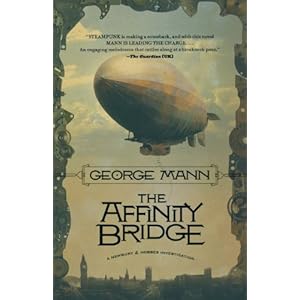
Book Review: The Affinity Bridge

The Affinity Bridge (Newbury & Hobbes Investigations) by George Mann

So I have a confession to make.  I'm getting a bit burnt out on steampunk books.  I've read a LOT of them in the last six months, and I've gotten to a point where they all seem a bit same-y (with some notable exceptions, of course.)  What hurts me even more is that I recently tried to read the first book in fairly well-known steampunk series and I disliked it so much I couldn't finish reading it.  No, I'm not writing a review of it.  But it left something of a bad taste in my mouth through its horrible writing.

So I'll be the first to admit I didn't read The Affinity Bridge in the best state of mind.  'Please let it be better than that last one,' I said under my breath while starting it.  And, thankfully, it was.  The writing is quite good, clear and straightforward and Victorian enough to give a little flavor without bogging down its plot.  The heroes of the book are Sir Maurice Newbury, anthropologist by day and secret agent of the queen by night (or ok, day as well..) and his assistant Miss Veronica Hobbes.  Sir Maurice is a comfortable Victorian gentleman, a scholar of the occult, and something of action hero.  Miss Hobbes is more of a mystery.  She seems at first to be little more than a hired secretary, but she's very intelligent and daring and Sir Maurice includes her in all details of his investigations.  Both characters are fleshed out in interesting ways over the course of the story, and there are indications of even more interesting developments in the future.

As for the plot, I'm less enthused about that.  But I can't tell you if there's anything actually wrong with it, or if its a symptom of my current overdose of steampunk fiction.  There's a series of mysterious murders by a spectral policeman, a mysterious airship crash, and clockwork automatons going berserk.      Oh, and the almost contractually required zombies.  I can't fault anything in these elements other than to say that I've seen very similar stories before.  But the real fault of the plot lay in the fact that the vast majority of the books is spent in long action sequences.  I've never found action sequences particularly interesting to read.  Often they just come off as someone trying to describe what something would look like in a movie.  Steampunk fiction loves action sequences, however.  I felt the ones in this book were too long, too frequent, and too difficult to believe. Sir Maurice, a scholar and an anthropologist, spends most of his time performing action movie hero stunts: fighting on the tops of trains, dangling from airships, fighting off zombies, being attacked by automatons... Around the third lengthy sequence in 24 hours of him being physically abused by all this action, I stopped believing in it.  I was also stuck wondering why he was always the only one who was involved in the action, even when he had his friend from the police force standing next to him.  I was starting to wonder if his friends just stand back and shake their heads, "Oh there goes Maurice, running after a train again..."

So, ultimately, yes, I recommend this book.  The characters are well done, and I'm interested in future books in the series.

As for me, I'm taking a break from steampunk fiction.  Because there are only so many books about male/female detective teams having adventures involving airships, clockwork men, and spooky stuff that you can read...


>