Wednesday, January 25, 2012

Upsizing a Pattern Tutorial

So I'm actually pretty new to sewing. Two years ago I'd never used a sewing machine. So there are things I've never attempted, and one of them was significantly increasing the size of a complicated pattern. But I fell in love with the New Look 6599 short-sleeved Victorian blouse pattern and it only went up to size 18. That wasn't going to work for my bust, so I needed to make it bigger.

I wasn't really sure how to go about that, so I asked my friend Linda of Rosewood Stitches. She quickly explained the technique shown in this post.

The idea is simple: cut your pattern pieces down the middle and add a strip of paper to make the pattern wider. I started by taking some careful measurements and figuring out how many inches I needed to add. Forgive me, because it's been a while since I did this, but I think I needed to add 6 inches in the hip, and slightly less at waist and bust. Anyway, I decided I needed to add 6 inches around. Since most of the room I needed was in the front for the bust, I decided to add 1 inch to the back pattern pieces and 2 inches to the front.

Here is the back piece after I added a one inch strip. (The weird black notch at the center back is actually just my corset getting in the way. Yes, I wear a corset to sew in.)


I'll show you more in-depth how I did this with the front piece. Here is the pattern piece for the front copied directly onto a new paper:


I didn't want to have to reposition the darts or mess with them, so I chose a spot just to the side of the dart to make my increase. I used my quilting ruler to draw a line.


I cut and spread the pattern piece along this line. (Actually, I think I just used my rotary cutter for this.


Then I made a strip of paper three inches wide and carefully marked off the 2 inches I needed to add to the pattern, with 1/2" on either side to tape to the back.


I carefully placed the pieces on top of this strip and taped them down.


Because I'm tall and long-waisted, I almost always have to add length to tops, so I did that as well. Sometimes I will cut and spread the pattern at the waist as I did above, but in this case I didn't want to interfere with all my complicated stuff already going on in this pattern, so I just added an inch to the bottom of the pattern piece.


I used my ruler to carefully mark 1 inch out all along the piece at one inch intervals.


Then I drew in the curve and cut along this. So here is my finished pattern piece:


But wait! We're not done! Because this pattern has a separate yoke pattern piece. So we have a problem:


So I added two inches to this piece, too:


But you can see that now this piece is something of a weird shape and all the lines on it no longer match up. Basically I just did my best to make the lines smooth and straight when I was sewing the pieces together. Here is the body of the blouse sewn together:


At this point I tried it on and it fit pretty well! The body was a decent fit for a blouse. If I had been ambitious, I could have taken some in at the waist to make it more tailored, but I'm the queen of "close enough." But I had a problem: the sleeves didn't come close to fitting. Increasing the size of the back and front had made the armscye or opening of the sleeve too small. And I have HUGE shoulders anyway that are hard to fit. So I took the sleeve off, cut back, put it back on, cut more off, put it back, etc. I just could NOT get the sleeve to be comfortable. Eventually I put the project to the side out of frustration.

About two months went by and then I approached the shirt DETERMINED to make it wearable. I tried the sleeves yet again. I referred to my new book on clothes fitting and construction. According to the book, the armscye was about the size it should be. Finally, I resorted to desperate measures. I threw out the small pouf sleeves and went with the larger pouf sleeves from the pattern. I'd used these sleeves before when my shoulders didn't fit in a sleeve, so I knew they worked for me. Since I had wanted smaller sleeves, I cut down the length of the large sleeves and used the small cuff from the small sleeves. Finally, the damn things fit. I could finish the rest of the blouse.

The only other problem I had was the collar. I wanted a plain standing collar and just went ahead and attached it as drawn in the pattern. I didn't think about the fact that the neckline was larger due to my adjustments. But since I already had the collar on, I decided I could totally live with the way it looked. And here is the finished blouse:


If I ever find my vintage lace again, I'll add some to the sleeve cuff. I need to reorganize my sewing area SO BAD. Here is a photo of the shirt with a steampunk outfit:

From Clockwork Con 2012

(Also pictured: my crew's bartender (check out the shot glass bandolier), and my captain in the background photobombing us.)

Ok, so that's done. Hope it helps someone!

Tuesday, January 24, 2012

My Latest Finished Projects

I have actually finished a bunch of projects in the last couple of months, but until now I didn't have decent pictures of them. So here's a quick show-and-tell.

-First is the coat from the Simplicity steampunk pattern. I made it without sleeves, cause I live in Texas.

From RealmsCon2011

This coat-vest-thing isn't a part of one of my regular outfits, but it's something I can throw on to slightly change what I'm wearing, provided I'm not wearing a bustle. It is not attractive with a bustle. The only downside is that I was just at a steampunk convention and I lost count of how many of these coats I saw at around seven. I mean, they pretty much all looked cool, but still. (The majority of them didn't have sleeves, which I kinda think is funny.) Also in that photo you can see a vest I made for my husband from the same fabric. It's the round front vest from the Simplicity 2870 vest pattern. It's my husband's favorite vest, and also the easiest I've made.

- My friend and first mate of my airship commissioned me to make her the outfit from the Butterick 4954 pattern. This past weekend was my first chance to see it on her, and I was so happy it didn't look horrible!

From Clockwork Con 2012

I also made the little top hat she's wearing. I made up the pattern for that myself and it came out great!

- When I realized that I had a couple of events to go to this winter and that even though it might be 80 or 90 degrees, it might also be 30 degrees, I realized I needed a jacket. I dug through my patterns and settled on this bolero pattern, and some black suiting that I had on hand. Here's the finished jacket with my black and silver outfit:

From Clockwork Con 2012

I added extra-large antique brass hooks and eyes for the closure in the front and pinned various medals on it. (Some of which were gifts, one that I made from a pendant and one which was actually the convention badge. All steampunk cons should have a medal badge option.) For the back I copied my husband's back patch from his coat.

From Clockwork Con 2012

-The above black and silver outfit includes my latest corset. I used my modified version of the Laughing Moon Silverado pattern, and then I modified it some more. Because I made changes on the fly without doing another mock-up I ended having a lot of problems and had to tear it apart a whole bunch of times. Note: Don't do that.


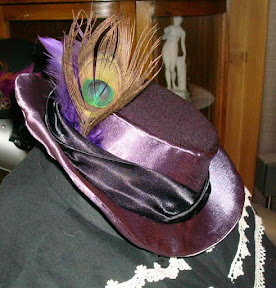
-I made another hat, intended for myself, using Truly Victorian's 1880's Hat Frame Pattern. Usually the TV patterns are EXCELLENT, but I didn't like this one so much. The instructions left out some important steps that the Lynn McMasters patterns have, such as covering your buckram with flannel before covering it will your fashion fabric. That step makes the hats feel much better quality. So I followed the McMasters directions to make this pattern's hat. I wanted something different, so I chose the low crown version. But I had a lot of problems getting the brim to fit on the crown correctly. It felt like they weren't drawn to really fit. Then the finished hat just looked horrible on my head, so I am going to try to sell it.


And I think that's all for now.

Monday, January 23, 2012

Con Report: Clockwork Con 2012

I just got home from Clockwork Con, in Austin, TX. This is the first time this con has been held and on the whole I was very impressed.

The con was well-organized. Things happened when and where they were supposed to. There was remarkably little visible chaos, but things weren't over-planned either. It was a fairly small con, but the level of attendance felt just about right. I have no idea what the numbers actually were. There was a good variety of panels and the entertainment was really good.

I attended with the entirety of my airship crew, the Airship Octavia XIII. By the time we arrived, unpacked, and dressed on Friday there wasn't much going on. The Octavia crew got a little too excited about being all together again and a couple of celebratory drinks turned into, well, a LOT of celebratory drinks (and beers, and shots, and some other unlabeled stuff in various bottles from people I've never met....). The burlesque show that evening was excellent, and I'm not that easily impressed by burlesque. There were some truly talented ladies among the troupe that performed.

Saturday was a much busier day both in terms of panels and events and also attendance. I attended the "Light-em-up gadgets" panel presented by some of the Celestial Rogues. I don't know what kind of lighting I might use for my own costumes, but if I ever am inspired to I feel I have a better idea of where to start now. After a disappointing lunch in the hotel restaurant, we moved on to the Gadgeteer's Festival. (Speaking of the hotel, it was a VERY nice place, with friendly staff, except in the the restaurant. Service was extremely slow, rude, and one of my crew members received his order cooked very incorrectly.)

I didn't have any items to show in the Gadgeteer's festival, but my captain did and I enjoyed wandering around and chatting with various makers. I then attended a panel on "Vintage Hair for the Modern Steampunk." The presenter was the head of the burlesque troupe, and it was absolutely one of the best panels I've attended. She demonstrated how to create several different steampunk and dieselpunk styles using hairpieces blended with your own hair. This is something I've been wanting to be able to do for AGES, and I'm totally going to start playing with my hair tomorrow. (I even have a wig I bought to try to make a Victorian updo, but that failed. Now I know how to cut it up and use it with my own hair to make pretties!)

After that our crew attended a panel titled "Victorian/post-apocalyptic mods." Our captain was assisting with the presentation along with Professor Steampunk and his wife. It turned into a sort of conversation about the philosophy of steampunk modding. I enjoyed it and there is talk of us developing some new panels together.

Another thing I appreciated about the way the con was organized: there were scheduled lunch and dinner breaks during which there was no programming. It allowed everyone to feed themselves, change, and get a break without feeling like they're missing something. So after the dinner break, the Saturday evening concert started with Bones Jangle and the Voodoo Island Cannibals, Steam-powered Giraffe, and Marquis of Vaudeville. Bones and the Marquis are regular performers in the Texas steampunk scene and it was nice to see them again. I had never heard Steam-Powered Giraffe, and they were great! I appreciate how committed they are to maintaining their personae as clockwork androids. After the show we retired, worn out from our partying the night before.

Sunday was typically busy, with the packing and checking out. I went to a panel on hats, which was a good introduction to different styles of Victorian hats and the different ways to make or mod them. Otherwise my husband and I didn't get to really experience much of the programming for the rest of the day. Lunch/breakfast was a necessity that caused us to miss a couple of events, and after some final vendor room purchases, we headed home.

Overall the con was really excellent, with lots of interesting panels and events and a great vibe. I would have liked to get to chat with more of the community than I did, but with so much stuff to do, everyone was occupied for most of the time.

Saturday, January 14, 2012

Corsetmaking Part 2: Corset Materials

Before I get into corset assembly methods, I need to talk a bit about materials.

Boning:
If you're going to the trouble to make your own corset, don't waste your time by using anything but steel boning. I've talked elsewhere about the evils of plastic corset boning, but let's just say steel is more comfortable, works and looks better, and lasts longer. The majority of corsets are made with solid flat steel bones at the back and front (i.e. the busk), with spiral steel bones everywhere else. The spiral steel bones are made up of steel wires and are very flexible. They can bend in any direction and will spring back to their previous shape.


The flat steels don't bend from side to side, but do flex in and out.

They can also be permanently bent either intentionally or unintentionally. Some corsetmakers prefer to use all flat steels to get more rigidity or because they feel it helps get more reduction in the waist. But the majority use spiral steel for comfort and because it can be placed along curved seams.

The most economical way to buy spiral bones is by the yard on a roll. You CAN buy them pre-cut and tipped, but it's WAY more expensive, plus if you make changes to your design on the fly, you may have to cut them anyway. But to cut the bones you will need a special tool, or steel cable cutters. (Make sure they are made for cutting steel. I bought some that looked great, but weren't for steel. The bones chewed them up.) You will also need to either attach special steel tips to the ends to make them round and smooth. These tips are notoriously difficult to get on unless you have a special press. One friend uses E-6000 to glue them on, which I might try. But I gave up on these fiddly things a while back and now I just use plumber's thread tape to wrap the ends. It doesn't have adhesive to gum up your corset and only sticks to itself. You can wrap as much as you want around, and it's CHEAP AS HELL. Plus, instant boning gratification. I just cut each bone as I sew its channel, wrap with tape, and insert. No pliers, no waiting for stuff to dry.

So I told you not to use plastic boning, and I meant it, but if you ABSOLUTELY HAVE to use plastic, because you need your corset tomorrow and can't wait to order steel boning online, don't go to the fabric store. Go to the hardware store and buy heavy-duty cable ties. They are stronger than any plastic boning sold for the purpose and they won't warp as easily as most of the stuff. I use it for mock-ups and for boning in places that aren't under stress, like a boned modesty panel.

Fabric:
There are three main types of fabric used in a corset, determined by their purpose: fashion fabric, strength fabric, and lining fabric.

Fashion fabric is the fabric that will show on the outside. It's the pretty stuff. This can pretty much be anything, but some fabrics are going to be easier to work with than others. I would avoid any fabric that is very lightweight at first, as it will be more difficult to make look smooth. But silks are popular choices, and since a corset really only requires about a yard of fabric, you can splurge on the nice stuff. I'm personally a big fan of using poly brocades. The thickness is nice, and I melt the edges of all my cut pieces with a candle to prevent any fraying. If you are using thin fabric, you may want to fuse it to your strength fabric using fusible web. Alternately you can flat-line your fashion pieces to your strength layer by sewing around the edges of each cut pattern piece. It makes the corset assembly easier later.

Strength fabric is usually one of two types of fabric: coutil or cotton duck. Coutil is the traditional fabric made specifically for corsetry. It is typically cotton, very densely woven into a herringbone pattern. The reason it is perfect for corsets is that it has NO stretch at all in any direction. It is the toughest fabric I've ever seen, but is also pretty lightweight and smooth. There is domestic (US) coutil and imported coutil. Imported has a higher thread count and is denser and therefore more expensive. The only downside to coutil is that it is difficult to find and it is pricey. It runs at least $20/yard, often more.

I've used it and though it's nice, generally I go for cotton duck for price reasons. However, if you're going to make a corset for everyday wear, I do recommend coutil. I have a corset I wear everyday made from cotton duck and after about six months, bones are starting to poke through and wear through. I'll be making another one from coutil.

Most people are familiar with cotton duck, though they may call it canvas. It's available in every fabric store in a range of colors and prints. The only thing to watch out for is to be careful not to buy any duck or canvas made for outdoor use. This is treated with a water-repellant chemical and you DON'T want to use this in a corset. It won't breathe at all and won't absorb sweat. Usually it's easy to avoid this stuff, but especially if you're buying a remnant be careful what you're getting. I buy all my duck in remnants. It doesn't matter what color or pattern it has, since no one will see it. (Unless it's your outside fabric also.)

For lining fabric, I recommend either cotton twill (if you want something sturdy, that can also act as a secondary strength fabric), or plain 100% cotton quilting fabric. Don't use the thin poly lining fabrics, they don't breathe and aren't strong enough. The only consideration otherwise is that due to twill's diagonal grain, you need to alternate the direction you cut your pieces in to prevent it from pulling strangely. Overall, I like quilting cotton. You can even use some really funky or silly print, since only you are going to see it.

Other materials:

You will need a busk for the front closure of your corset, grommets for the lacing holes, laces, and ribbon, bias tape, or self-fabric bias for the binding. There are alternatives to most of these, but these are the typical supplies needed.

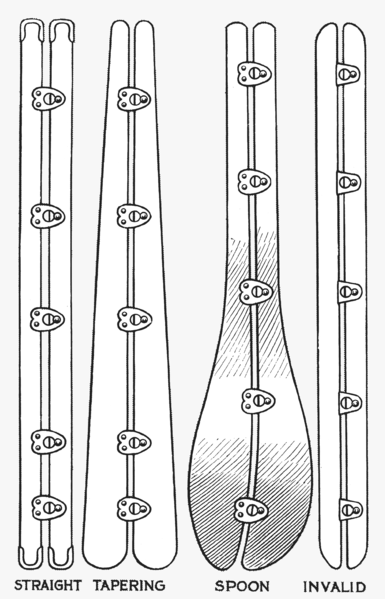
This illustration shows different styles of busks. Generally, you will use a straight busk, unless you're recreating a historical corset that used some other style. There are different strengths of busks and often it depends on where you buy them. A heavy-duty busk will hardly bend at all, which can be what you want or it can remove some of the curves from the shape of your corset. But too flimsy of a bust may be really difficult to close, and may cause other fit problems. Unfortunately, I haven't really learned a way to predict what kind of busk I'm getting, except by trial and error and learning which distributors I like.

Where to Buy:
Speaking of which, let's talk about where to buy supplies. Unless you live in New York, LA, London, or Paris, it's unlikely there is a corset supply store in your town. So the internet is your friend. There are several corset supply websites, but I don't have experience with all of them.

Corsetmaking.com - This store has pretty much everything you might ever need to make a corset. I've bought from them most often. Their standard busks are a little flimsy, their heavy bones are REALLY thick, and I love their boning cutter. Also, they have nice grommet colors like antique silver and antique gold.

Dragontown Corset Supply- I really like their busks. They are a nice middle-of-the-road option.

Faire Lady Designs on Ebay - I really like this shop, and she has some great prices on spiral steel boning. But her corsetmaking stock is thinner than it used to be. Good quality clothes, though, FYI.

Farthingale's - I've never ordered from them, but they have some difficult to find items, like lacing d-rings. They also have an LA store.

Vena Cava - A UK site, but the only place that sells swing hooks and drilled bones for a swing hook closure. (Which I'm going to have to order soon, note to self.)

Ok, so I HOPE that's all the info I needed to get out prior to my NEXT post on corset assembly.
>