Sunday, February 27, 2011

A Victorian Vest

I've neglected this blog this month. For part of the month I was bedridden due to a very severe flare of back pain, so I couldn't work on my various steampunk projects. Thanks to some shots to the spine, I'm at least back to my normal level of dysfunction and am plowing through some exciting projects. I'm preparing to offer a couple of patterns of my own soon.

But one project I have (finally) completed is a Victorian Waistcoat or Vest for my husband.

From sewing

From sewing


The vest was made from the pattern Simplicity 2895 and since it's a commercially available pattern I won't go into detail on how to make it. Wait for a $0.99 or $1.99 sale and buy the pattern. It's also got a nice period shirt and frock coat. The fabric is a home dec remnant I found at Hobby Lobby. I'm so thrilled I was able to get enough fabric for this from a remnant.

I've actually been working on this since November. I initially wanted to have this done for Dickens on the Strand, but the welt pockets gave me hell. After four days spent trying to figure out how to do one pocket, I gave up and stuck the project in a bag. When I went back to it this month, I was surprised to find that suddenly the instructions as written made sense and I was able to finish them with a minimum of difficulty.

Sewing period items like this reminds you of why clothes used to be custom made or at least custom altered by a tailor. Now we all wear stretch clothing or baggy T-shirts. But when you're dealing with an item as fitted as a vest, it's unlikely that one size is going to fit all. Since I had a limited amount of fabric, I was forced to alter the size by adding panels to the shoulders and the sides. I added a two inch insert in the shoulder seams to increase the length to fit my long-waisted husband. And then I added a few inches to the sides to ensure the vest would close properly. I really need to start thinking about these things before I start cutting. But if the alterations are not as gorgeous as I might have wanted them to be, the final result fits well and looks good.

NOTE: I now have a tutorial posted on how to make the welt pockets! It only took me a year to get comfortable with them!

Thursday, February 3, 2011

Steampunk Knitting

Way before I started sewing or even being interested in steampunk, I was knitting. Naturally I've looked for ways to combine these interests. So here are some of the Steamy things I've made with string and some sticks.

Belle Ruffle Gloves:
From knitting

Pattern by VOKnits is here.

Aviator Hat:
From knitting

Pattern, also by VOKnits, is here. The steampunk buttons I used are from Treasure Cast Steampunk Buttons and are great quality and gorgeous.

Staghorn Mitts:
From knitting

I made these mostly to keep my husband's hands warm at work. But he has also added them to his steampunk costume. Pattern available here.

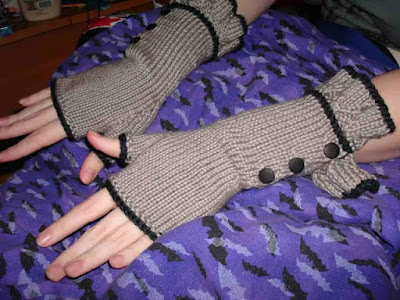
1965 Arm warmers:
From knitting

I didn't make these for any steampunk purpose; I just loved them. But I think the finished product is very steamy. The pattern is from the (excellent) book Knitting 24/7 by Veronik Avery.

I have plans for many more steamy projects. I'm working on a Camden sweater now, with a modified front panel.

I'm perhaps most excited to knit my own parasol, with the Lady's Bumbershoot pattern from the fantastic collection of steampunk patterns at The Sanguine Gryphon.

And because one can never have too many fingerless gloves, I'm dying to make these Opera Length Lace Gloves.


A new Must Knit pattern for me is the amazing Sleeved Mantelet by The Jane Victoria. Maybe I can have it ready for next winter.

And finally, I'll bet you didn't think you could knit a corset, but you can. The Prim Reaper's Corset. Yes, I bought a book called Vampire Knits (on sale) just for this pattern.

For more steampunk knitting patterns, I recommend the Ravelry group Steamy Stitches. The folks over there are great at pointing out patterns with at steampunk flair.

All this reminds me that I was pondering making myself some steampunk knitting needles to attach to my utility belt. I need to get on that...

Wednesday, February 2, 2011

How I made my bustle skirt

A year ago I was looking at beautiful Victorian dresses online and wishing I could afford to have someone make one for me. I never imagined that I would ever be making one myself. Creating a full Victorian costume is a goal of mine. I'd like to do that in the next year. But I started small and made myself a bustled overskirt.

I had an idea of what I wanted: a draped front and a cascading bustle of fabric in the back. I looked at various online resources, like this one and this one. But they weren't exactly what I had in mind, so I looked at commercial patterns for sale.

I did spend a lot of time at Truly Victorian studying their patterns. Although their stuff is awesome, I just didn't see exactly what I had in mind. Their patterns are authentic, and I actually wanted something simpler, sleeker than actual Victorian designs. Finally, I found this Burda pattern and it is very close the the style of dress I eventually want to make. Plus, the draped overskirt is exactly what I wanted. The pattern is out of print, but available to download, so I bought it, downloaded it, and printed it. I've never used a downloaded pattern, and the process of laying out the sheets in the right order, gluing them together, and finding the pieces I wanted took a while. Tissue paper would be easier.

But once I looked more closely at the pattern, I was disappointed with the back of the overskirt. It's really just plain skirt with some vertical pleats over a padded bum roll. I wanted something more like the bustle on this dress. I already owned that pattern, having picked it up in a $0.99 sale. The actual dress looks more 18th century than 19th century to me, but the bustle is very easy to make and buttons on to a waistband.

So I set out to make a skirt with the front of the Burda pattern and the back of the McCall pattern. For someone who only learned to use a sewing machine about 5 months before, this was a pretty big deal. The front was pretty easy, and the bustle was fairly easy, but putting them together was a little tricky.

Because I think the technique on the bustle would be useful to some people, I'm going to try to describe the process. There are two layers of fabric, your desired show fabric, and a lining. I used home decor fabric in a sateen stripe. It's a good idea to use pretty heavy fabric to get it to drape correctly. The underside of the bustle is an elongated trapezoid slightly less wide than your desired width of the bustle. The actual bustle is much larger and is cut in two long strips almost as wide as the fabric and then sewed together in the middle. Along the sides of the bustle there are three large pleats that are folded and then the whole thing is sewn to the underside piece, right sides together. So you have the bustle as a large piece of fabric sewn to a much smaller piece, leaving the fabric loose and billowy. You then tack the bustle to the lining in three or four places, to form the flounces however you want.

I apologize for not having step by step pictures to illustrate the process, but I made this in November, before I started this blog. I tried to draw an MSPaint illustration, but really, you don't want to see that. Hopefully you can get a sense of what I mean from the finished product.

From sewing

From sewing

From sewing

From sewing


As for attaching the two halves, I only finished that recently. For Dickens on the Strand, my bustle was held on with safety pins. But I finally attached the bustle on one side of the waistband and created a series of button holes in the waistband to attached the bustle firmly to the skirt.

If I had it to over, I would have made the bustle panel wider and used a stiffer material for the under layer. I have since improved the look with my new favorite fabric trick: starch. After starching the under layer and the bustle itself, it looks better when worn.
>